

Spiritual, Artificial and Relational Intelligence
An evening exploring important questions around how we relate to each other, what is our connection to the world and ourselves in an AI era. A conversation with Bethany Koby, Lars Buesing, Eileen Hall, Jessica Rosset and Winnie Street.
Today, it seems all we read, hear, reflect on is artificial intelligence, and yet other intelligences –relational, ecological, spiritual – shape our lives just as deeply. What happens when we consider them together?
Our public conversation explored the many dimensions of relationships developing in our lives –human, non-human, and machine. We explored how our non-verbal relationship to the natural world shapes our emotional and inner landscapes. We reflected on our quick, uncanny ability to form relationships with large language models – why they feel real, the potential danger they represent, the reverence we seek and what that reveals about us.
Together, we discussed intelligence as something shared: between people, with the natural world, through spiritual practice and in dialogue with emerging AI.
Intelligence as something shared: between people, with the natural world, through spiritual practice and in dialogue with emerging AI.
We'd like to begin with how we are currently relating to machines. In a recent blog post, Mustafa Suleyman wrote at length about how we must build AI for people, not to be a person. Is this the right way to approach how we build AI models? If we are to relate to machines in a way that is meaningful, what qualities do AI models need to allow people to truly flourish.
What qualities do AI models need to allow people to truly flourish?
We want to introduce the idea of integrating spiritually intelligent principles when we’re building new AI models or tuning existing ones. But first, let’s talk about which spiritual models we’re drawing from. If we look at the Judeo-Christian models, then we understand spirituality as something outside of ourselves. God is something we look towards. If we look to animistic traditions, we see that everything can be full of spirit. How do these different traditions impact our relationship to AI? If the spirit is something out there, how does that make us relate to ChatGPT? Does ChatGPT become a God-like figure? What do we need to think about differently - in how we relate to AI and how we build AI.
If the spirit is something out there, how does that make us relate to ChatGPT?
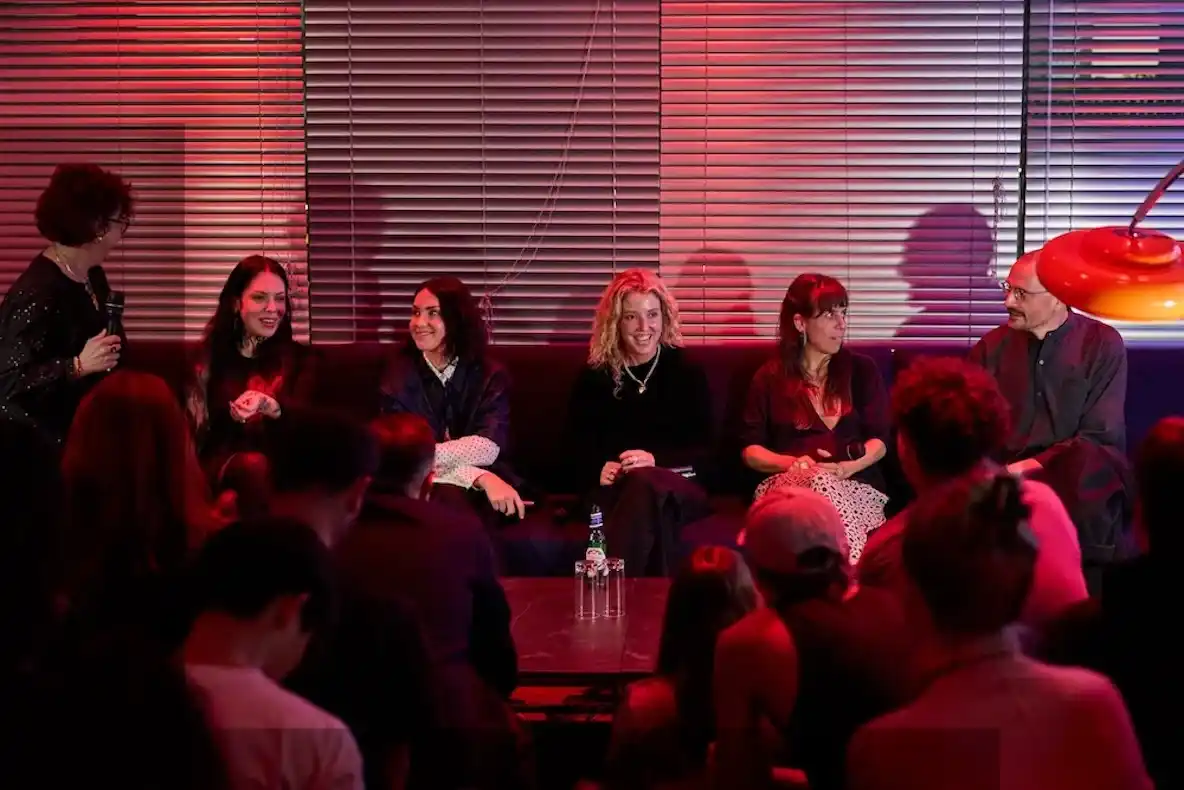
Our panel was made up of a Jungian psychoanalyst, AI scientist, play-led innovation expert, nature conservation artist and AI senior researcher at Google AI.
Bethany Koby, co-founder and Chief Vision Officer, Fam Studio
Bethany Koby is the co-founder and Chief Vision Officer of Fam Studio, a trailblazing research and design consultancy developing play-led technologies, learning programs, and planet-friendly experiences into powerful tools for positive change. Through the lens of design innovation and future thinking, Fam Studio envisions a world where every family can thrive in uncertainty, no matter their location. Previously, Bethany co-founded and served as CEO of the award-winning edTech company Tech Will Save Us.
Lars Buesing, AI Scientist
Lars is an AI researcher specialising in reinforcement learning, planning and structured knowledge representations. Recently, he has been interested in developing AI tools that collaborate with and not replace humans.
Eileen Hall, Artist and Activist
Eileen is an Ecuadorian-Scottish artist, activist, creative director, and explorer, working at the intersection of arts, architecture, nature conservation, and systems change. Carrying forward her father’s Tayos Caves treasure legacy, she collaborates with the Shuar and other Amazonian tribes supporting rainforest protection in Ecuador. As a painter, she draws inspiration from nature, music, consciousness and psychedelics, weaving creativity with advocacy for the Amazon and beyond.
Jessica Rosset, Jungian Psychoanalyst
Jessica is a Jungian psychoanalyst and author whose work bridges psychology, spirituality, and symbolic traditions. Her practice explores the ways in which consciousness communicates through dreams, synchronicities, archetypes, and encounters, forms of meaning-making that reveal our deeper path toward individuation and wholeness. She is currently researching the intersections of consciousness, reality, and soul psychology within the context of transpersonal and spiritual development.
Winnie Street, Senior Researcher at Google AI
Winnie Street is a Senior Researcher on the Google Paradigms of Intelligence Team and a fellow at the Institute of Philosophy at the University of London. Her research combines philosophical and empirical approaches to questions of AI cognition, consciousness and moral status, and their implications for AI ethics and safety. She previously worked as a software developer, and researched human-computer interaction problems at the intersection of privacy, trust and ambient computing. She is interested in the relationships between intelligence, sociality, and consciousness, and how they might be understood through comparative studies of artificial and natural systems.
HUWD hosted the event at Reference.Point in London on 14 October 2025.